

Staying up to date with Technology
With the rapidly changing tech industry and the endless stream of online learning resources, keeping your skills current can feel almost impossible.
Jacques Leemans · October 30, 2019 · 12:38 pm · Education, LEEEN Learning, Lifelong Learner, Online Learning, Sharpen the Saw
With the rapidly changing tech industry and the endless stream of online learning resources, keeping your skills current can feel almost impossible.
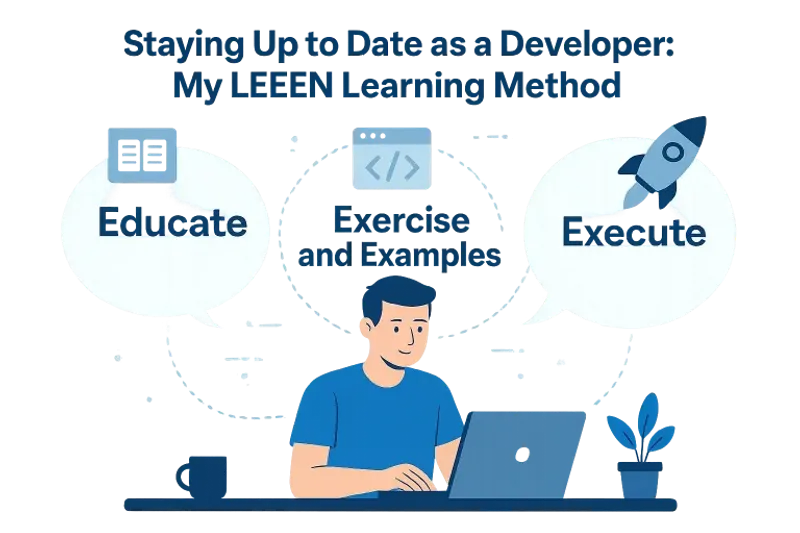
As a full-stack developer, I rely on a few key sources and follow what I call the LEEEN Learning Method:
- E: Educate
- E: Exercise and Examples
- E: Execute
This simple process keeps me focused and helps me grow as both a developer and a lifelong learner.
1. Educate: Keep Learning Every Day
Even if you’ve done the same “Hello World” in C++ a hundred times, doing it again keeps your mind sharp. You might notice something new, or understand an old concept differently than you did in the 90s.
Here are some of my go-to learning platforms and resources:
Khan Academy
Khan Academy, is one of my favourite online learning sites because of its wide range of subjects. I think of it as “getting back to basics.”
If you ever want to refresh your maths skills, they offer a full learning pathway from kindergarten to university level.
Their mobile app could use some improvement, but it’s still great for quick lessons or motivating the kids to learn something new.
Pluralsight
When it comes to technology skills, Pluralsight is my top choice. They offer high-quality, well-structured courses across development, IT, and creative fields.
I especially appreciate the older Digital Tutors content (before Pluralsight acquired them), which covers game development, 3D modelling, and animation. All of this aligns well with my work in Unity.
LinkedIn Learning
LinkedIn Learning has some useful tech courses, but I mainly recommend it for business and professional development.
It’s great for learning project management, entrepreneurship, finance, and even productivity tools like Google Sheets.
Udemy
Udemy is a bit of a double-edged sword. There’s always a sale on, and FOMO (fear of missing out) can easily kick in. You buy a handful of courses and then forget to actually do them!
That said, with a little discipline, Udemy offers some brilliant budget-friendly coding courses and tutorials for specific frameworks or tools.
Books
Despite all the online content out there, I still love reading books. For digital reading, I use the Kindle app, not just for buying from Amazon, but also because you can upload your own PDFs simply by emailing them to yourself.
For book bundles, Humble Bundle is my go-to store. For instance, I recently picked up the Programming Cookbooks by O’Reilly bundle, which included:
- Windows PowerShell Cookbook
- Regular Expressions Cookbook
- PHP Cookbook
- SQL Cookbook
- Python Cookbook
- Docker Cookbook
- CSS Cookbook
- Arduino Cookbook
- Raspberry Pi Cookbook
- and more…
It’s packed with practical, hands-on examples that are perfect for developers who prefer to learn by doing.
2. Exercise and Examples: Practise What You Learn
Just like any sport, the more you practise, the better you get.
I enjoy looking at existing games and apps, then trying to replicate specific features just to understand how they were built. It’s a great way to reinforce what you’ve learned and explore real-world applications.
If you can find open-source projects, study them. Even if it’s just to see what not to do, analysing someone else’s code is a powerful learning exercise.
Try setting small challenges for yourself. Build a simple game mechanic, web app feature, or Unity prototype. Every small project adds to your experience.
3. Execute: Apply Your Knowledge in Real Projects
Once you feel comfortable with a skill, start a real-world project.
It doesn’t have to be commercial. Build something for yourself, like a small mobile game or app, and publish it on the app stores.
The goal isn’t to make money (though that’s a bonus), but to experience the full development lifecycle, from concept to release.
The best way to grow as a developer is to get feedback from actual users.
You’ll quickly learn what works, what doesn’t, and how to improve next time.
Keep Learning, Keep Evolving
Technology never stands still, and neither should we.
By educating yourself, practising regularly, and applying what you’ve learned, you’ll stay ahead in an ever-changing industry.
Stay curious. Keep experimenting. And remember: every new skill you learn builds on the last.
Keep learning!
Cheers,
Jacques